
From where did all the energy come from if it can neither be created nor destroyed?
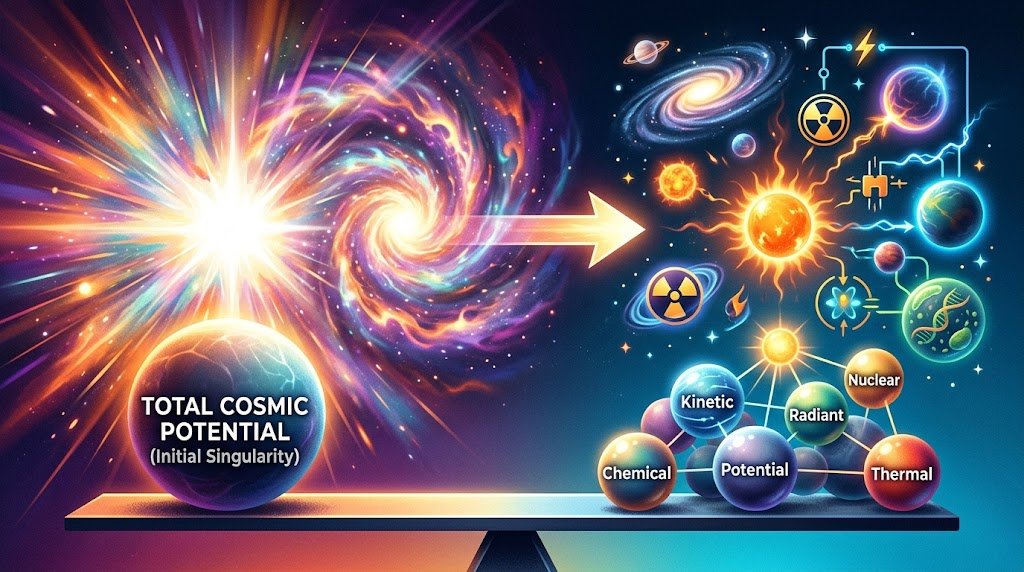
From Where Did All the Energy Come From If It Can Neither Be Created Nor Destroyed?
The question “From where did all the energy come from if energy can neither be created nor destroyed?” sounds simple, but it leads directly into some of the deepest questions in physics and cosmology. We learn in school that energy cannot be created or destroyed. Instead, it can only be transferred or transformed from one form into another. This statement is known as the law of conservation of energy. Once we understand this law, however, a natural question appears: if energy cannot be created, where did the energy of the universe come from in the first place?
The question becomes even more fascinating when we think about the beginning of the universe. Scientists describe the early universe as an extremely hot, dense state that expanded and cooled over time. Everything we see today, including galaxies, stars, planets, living organisms, oceans, and even the atoms in our bodies, can be traced back to the early universe. If all of this ultimately comes from the early universe, it is reasonable to ask what happened before that and where the original energy came from.
The answer is not as simple as saying that the universe received a certain amount of energy from somewhere else. Modern physics does not currently have a complete, experimentally confirmed explanation for an absolute “beginning” of energy. In fact, the question itself may contain assumptions that do not apply to the universe as a whole. The law of conservation of energy is extremely successful within physical systems, but applying it to the entire universe requires care because general relativity and an expanding universe make the concept of total cosmic energy much more complicated.
To understand the issue properly, we need to separate several ideas. We need to understand what energy actually means, what conservation of energy means, how energy behaves in everyday systems, what the Big Bang theory says, what happened during the early universe, and why asking where the universe’s total energy came from is different from asking where the energy in a particular object came from.
What Is Energy?
Energy is one of the most important concepts in physics. In simple terms, energy is associated with the ability of a physical system to undergo change or perform work. It appears in many different forms, including kinetic energy, potential energy, thermal energy, chemical energy, electrical energy, nuclear energy, and electromagnetic radiation.
When a moving car slows down, its kinetic energy does not simply disappear. Some of the energy is transferred into heat through friction, some becomes sound, and some may be transferred to the surrounding environment. When a battery powers a flashlight, chemical energy inside the battery is converted into electrical energy, and the electrical energy is transformed into light and heat.
This idea is central to the conservation of energy. Energy can move from one place to another and can change from one form into another, but in ordinary physical processes, the total amount of energy in a properly defined isolated system remains constant.
This does not mean that every individual object always has the same amount of energy. Objects can gain or lose energy. What remains conserved is the total energy when all relevant transfers and transformations are included.
For example, imagine a ball held above the ground. The ball has gravitational potential energy because of its position in Earth’s gravitational field. When the ball is released, that potential energy is transformed into kinetic energy as the ball accelerates downward. When it hits the ground, its kinetic energy is transformed into sound, heat, deformation, vibrations, and other forms of energy.
The energy did not vanish. It changed form.
The Law of Conservation of Energy
The law of conservation of energy is one of the foundational principles of physics. It tells us that energy is conserved in an isolated physical system. This principle is closely related to a deeper mathematical idea called symmetry.
In modern physics, conservation of energy is connected with the fact that the laws of physics are generally unchanged when we shift the time at which an experiment is performed. This connection is formalized through Noether’s theorem.
If the fundamental laws of a physical system do not depend explicitly on time, there is a corresponding conserved quantity that we identify as energy.
This is one reason energy conservation is so powerful. It is not simply an arbitrary rule that scientists invented after observing machines. It is deeply connected to the mathematical structure of physical laws.
However, applying the conservation principle to the entire universe is more complicated than applying it to a laboratory experiment.
Energy Is Not a Substance
One reason the question can become confusing is that we sometimes imagine energy as if it were a physical substance stored somewhere. It is tempting to picture the universe as containing a huge tank filled with energy and then ask who filled the tank.
But energy is not a material substance like water or gas. Energy is a measurable property of physical systems.
A moving object has kinetic energy. A compressed spring has potential energy. A hot object has thermal energy. A photon carries energy. A gravitational system can have potential energy. A field can possess energy.
When we ask “Where did the energy come from?” we therefore need to specify what physical system we are talking about and what process transferred or transformed the energy.
For a car, the answer is straightforward. Chemical energy stored in fuel is transformed into thermal energy and mechanical energy. For a plant, energy comes primarily from sunlight and is converted through photosynthesis into chemical energy. For a star, energy is produced through nuclear processes. But for the universe as a whole, there is no obvious external environment from which energy was supplied.
That is where cosmology becomes difficult.
What Does the Big Bang Theory Actually Say?
The Big Bang theory is often misunderstood. Many people imagine it as an explosion that occurred at one location in empty space, sending matter outward into an already existing universe.
That is not the modern picture.
The Big Bang model describes an early universe that was extremely hot and dense and has been expanding and cooling over cosmic time. Space itself is part of what evolves.
When scientists say that the universe was once much hotter and denser, they are describing the early state of the observable universe. The theory successfully explains a large amount of evidence, including the cosmic microwave background, the expansion of the universe, and the observed abundance of light elements.
The Big Bang theory does not necessarily provide a complete explanation of what caused the universe to exist in the first place.
This distinction is extremely important.
Saying that the universe was once extremely hot and dense is not exactly the same as explaining why there was a universe at all.
Did the Big Bang Create Energy?
It is tempting to say that the Big Bang “created all the energy.” However, this statement is more complicated than it sounds.
The Big Bang theory describes the evolution of the early universe, but our established physical theories do not provide a complete description of an absolute beginning. When we mathematically extrapolate classical general relativity backward, we reach a regime where densities and temperatures become extremely extreme and our existing theory is expected to become incomplete.
Scientists therefore do not have a confirmed theory that explains the ultimate origin of everything from nothing.
Some hypotheses propose that the universe could emerge from quantum processes. Some cosmological models suggest that the total energy of the universe might be zero when positive energy associated with matter and radiation is balanced by negative gravitational energy. Other ideas involve inflation, quantum cosmology, bouncing universes, or multiverse scenarios.
These are active areas of theoretical research, not established answers.
The Meaning of “Before the Big Bang”
Another important issue is the word “before.”
In everyday life, every event has something that happened before it. If a building was constructed yesterday, we can ask what happened the day before. If a tree grew, we can ask what existed before the tree.
But the universe is different because time itself is part of the physical description of the universe.
According to classical general relativity, space and time are combined into spacetime. The expansion of the universe is therefore not simply matter moving through an unchanging background. The geometry of spacetime itself evolves.
If time has a finite beginning in a particular cosmological model, then asking what happened “before” that beginning may not have the same meaning as asking what happened before breakfast.
It is similar to asking what is north of the North Pole. The problem is not necessarily that we have failed to find the answer. The question may be using a concept outside the range where it applies.
That does not prove that the universe definitely had a beginning in this specific sense. It simply shows why the phrase “before the Big Bang” is not straightforward.
Where Did the Energy of the Universe Come From?
This is the heart of the question.
The most scientifically honest answer is that physics does not currently provide a universally accepted, experimentally confirmed explanation for the ultimate origin of the universe’s total energy.
There are several reasons.
First, energy conservation is straightforward in many ordinary physical systems but becomes subtle in an expanding universe described by general relativity.
Second, the universe does not appear to be a system sitting inside a larger observable container from which energy was supplied.
Third, our current theories do not fully describe conditions that may have existed at the earliest possible moments of cosmic history.
Fourth, the total energy of the universe may not be a simple, globally conserved number in the same way that the energy of a closed laboratory system is.
These points do not mean that conservation of energy is wrong. They mean that the concept must be applied carefully in cosmology.
Energy Conservation in an Expanding Universe
One of the most interesting examples comes from light.
Imagine a photon traveling through an expanding universe. As the universe expands, the wavelength of the photon is stretched. This phenomenon is known as cosmological redshift.
For a photon, energy is related to frequency. Higher-frequency photons have more energy, while lower-frequency photons have less energy.
As cosmic expansion stretches the wavelength, the frequency decreases, and the photon loses energy according to the usual relationship between photon energy and frequency.
This raises an obvious question: where did that energy go?
In a simple laboratory situation, we might expect the lost energy to appear somewhere else. But in general relativity, an expanding universe does not necessarily have a globally conserved total energy in the same straightforward sense as a stationary isolated system.
This is one reason cosmological energy conservation is subtle.
The mathematics of general relativity allows local conservation laws to remain valid while a simple global definition of total energy for the entire expanding universe may not exist.
Local Conservation Versus Global Conservation
It is useful to distinguish local conservation from global conservation.
Locally, physics is extremely consistent with conservation principles. In a sufficiently small region of spacetime, energy and momentum obey conservation relationships expressed through the equations of general relativity.
Globally, however, the situation depends on the geometry and structure of spacetime.
In ordinary physics problems, we often assume a system is isolated and exists against a fixed background. Under those conditions, total energy conservation is easy to define.
The universe itself does not necessarily satisfy those assumptions.
There is no external laboratory surrounding the universe, and spacetime itself is dynamic.
Therefore, asking for “the total energy of the universe” may not always produce a unique answer without specifying exactly how energy is being defined.
Could the Total Energy of the Universe Be Zero?
One interesting idea explored in cosmology is that the universe’s total energy could potentially be zero.
This idea arises from considering positive contributions such as matter and radiation alongside negative gravitational potential energy.
Matter and radiation contribute positive energy. Gravitational systems, under certain descriptions, can be associated with negative gravitational energy.
If the positive and negative contributions exactly balance, the total could be zero.
This has sometimes been used to explain how a universe could potentially arise without requiring a net energy input.
However, this idea needs to be treated carefully. The concept of gravitational energy in general relativity is much more complicated than ordinary potential energy in Newtonian physics. There is no universally accepted simple local gravitational energy density in general relativity.
Therefore, the statement that “the universe has exactly zero energy” is not an established experimental fact.
It is better understood as an idea that appears in certain theoretical approaches.
Does “Nothing” Mean Empty Space?
Another major source of confusion is the word “nothing.”
In everyday language, nothing means the complete absence of everything.
In physics, however, the word vacuum has a technical meaning.
A physical vacuum is not necessarily absolute philosophical nothingness. Quantum fields exist even in regions with no ordinary particles, and quantum theory predicts that fields can possess fluctuations and other properties.
Therefore, when a physicist says that a universe might arise from a quantum vacuum, this does not necessarily mean that it emerged from absolute nothing.
A quantum vacuum is part of a physical theoretical framework.
This distinction matters greatly when discussing claims that physics has explained how “something came from nothing.”
Quantum Physics and the Early Universe
Quantum mechanics becomes increasingly important when we consider extremely small scales and extremely high energies.
The early universe was so hot and dense that quantum physics played a fundamental role in its behavior.
Scientists have strong evidence that the universe passed through phases where particles and radiation were in extreme thermal conditions. But the exact quantum description of the earliest possible moment remains an open problem.
A complete theory of quantum gravity may be needed to understand the deepest origin of spacetime itself.
Physicists are exploring several approaches to this problem, but none has yet been experimentally confirmed as the final theory.
Inflation and the Early Universe
One important idea in modern cosmology is cosmic inflation.
Inflation proposes that the universe underwent an extremely rapid period of expansion during its early history. It was introduced to address several puzzles in cosmology, including why the observable universe appears so uniform on large scales and why its geometry is close to flat.
Inflation can also help explain the origin of tiny density variations that later grew into galaxies and other cosmic structures.
However, inflation does not automatically answer the ultimate question of where all energy came from.
Different inflationary models have different mechanisms and assumptions, and questions remain about how inflation began and how it ended.
Therefore, inflation is an important part of cosmological research but not a final explanation for the origin of existence.
Matter and Energy Are Related
Another important concept is the relationship between matter and energy.
Einstein’s famous equation, E = mc², tells us that mass is associated with energy. This means that matter can be converted into other forms of energy under appropriate physical processes.
For example, nuclear reactions can convert a small amount of mass into a large amount of released energy. Particle-antiparticle annihilation can convert matter and antimatter into radiation.
The reverse can also occur. Under suitable conditions, energy can produce particles with mass.
This means that asking where “matter” came from and asking where “energy” came from are closely related questions.
The early universe contained extremely energetic conditions in which particles could be created and destroyed through physical interactions.
Energy in Stars
Stars provide a beautiful example of energy transformation.
Our Sun produces energy primarily through nuclear fusion. In the solar core, hydrogen nuclei participate in reactions that ultimately produce helium and release energy.
That energy travels outward through the Sun and eventually reaches Earth as electromagnetic radiation.
Plants capture some of this solar energy through photosynthesis. Animals and humans obtain energy by consuming food. Our bodies convert chemical energy into movement, heat, electrical activity, and many other processes.
If we trace the energy backward, we eventually reach nuclear processes in the Sun and earlier cosmic history.
This illustrates an important point: the energy we experience every day has a long history of transformation.
Energy in Human Bodies
The food we eat contains chemical energy. Plants store energy from sunlight in chemical bonds during photosynthesis. Animals obtain chemical energy by consuming plants or other organisms.
Our cells then convert chemical energy into forms that can be used for biological processes.
When you walk, your muscles use chemical energy. When you maintain body temperature, chemical energy is converted into heat. When your heart beats, chemical energy supports mechanical activity.
The energy in your body is therefore connected to a chain of transformations extending backward through food, plants, sunlight, nuclear fusion, and ultimately the early universe.
This does not mean we have identified the absolute origin of energy. It means we can trace energy transformations through increasingly earlier stages.
Energy in the Earth
Earth receives energy primarily from the Sun, although Earth’s internal heat also has important sources.
Solar energy drives weather, ocean circulation, plant growth, and much of the Earth’s surface activity.
Earth’s internal heat comes from several sources, including residual heat from Earth’s formation and radioactive decay of elements inside the planet.
Again, the important idea is transformation.
Energy moves through different systems rather than appearing randomly.
The Energy We Use Every Day
Electricity is another example.
A power plant does not create energy from nothing. Depending on the type of power plant, it converts energy from fuel, moving water, wind, sunlight, or nuclear reactions into electrical energy.
A coal power station converts chemical energy into heat, then mechanical energy, and eventually electrical energy.
A hydroelectric plant converts gravitational potential energy associated with water into kinetic energy and then electrical energy.
A wind turbine converts kinetic energy from moving air into electrical energy.
Solar panels convert electromagnetic energy from sunlight into electrical energy.
Each example demonstrates the conservation principle.
Chemical Energy and Conservation
Chemical reactions also demonstrate energy transformation.
When wood burns, chemical energy stored in the material is converted into heat, light, gases, and motion of particles.
The energy was not created when the wood caught fire. It was already stored in the chemical structure of the material.
Similarly, when food is metabolized, chemical energy is transformed into forms that the body can use.
The phrase “energy is created” is often used casually, but scientifically it is usually more accurate to say that energy is converted or transferred.
Why Does Energy Exist at All?
This question goes deeper than ordinary conservation laws.
We can describe how energy behaves, how it changes form, and how it is related to the laws of physics. But asking why energy exists at all is partly a question about the fundamental structure of reality.
Physics is extremely good at describing relationships between measurable quantities. It can tell us how systems evolve when certain conditions are given.
But the question of why there is a universe governed by physical laws in the first place may go beyond what current experimental physics can answer.
This does not make the question meaningless. It means that we should distinguish between scientific explanations that can be tested and philosophical questions that may require broader forms of reasoning.
Could the Universe Have Come From a Quantum Event?
Some theoretical models suggest that the universe could have originated through a quantum process.
Quantum theory allows systems to behave in ways that are very different from everyday classical intuition. Quantum fluctuations are part of the behavior of quantum fields.
Some cosmological theories attempt to describe the origin of the universe through quantum cosmology.
However, these proposals are not simple, experimentally established answers to the question of ultimate origin.
A model may mathematically describe a possible beginning without proving that this is exactly what happened in reality.
This distinction between possibility and established fact is essential in science.
Is Energy Conservation Ever Violated?
In ordinary physical processes, energy conservation is extraordinarily well supported.
There are sometimes popular claims that quantum mechanics allows energy to appear from nowhere. This is usually an oversimplification.
Quantum theory does not provide a simple loophole allowing unlimited energy to be created without consequence.
Certain quantum processes involve temporary fluctuations and uncertainty relationships, but they do not provide a practical mechanism for generating unlimited usable energy from nothing.
Physics remains governed by precise mathematical relationships.
What About Virtual Particles?
Virtual particles are another source of popular confusion.
In quantum field theory, virtual particles are mathematical components of calculations describing interactions. They are not simply tiny ordinary particles appearing from nothing and disappearing again.
Popular explanations sometimes say that particles “borrow energy from the vacuum,” but this language can be misleading.
Quantum field theory is more subtle than this metaphor suggests.
The vacuum is a physical state described by quantum fields, and the behavior of those fields is governed by the theory’s equations.
The Role of Gravity
Gravity makes the origin-of-energy question particularly interesting.
In Newtonian physics, gravitational potential energy can be treated relatively easily in many systems. In general relativity, however, gravity is understood through the geometry of spacetime.
Mass and energy affect spacetime geometry, and spacetime geometry affects the motion of matter and radiation.
Because gravity is not simply another force sitting inside fixed space, defining gravitational energy globally can be difficult.
This is one of the reasons cosmological energy questions are more complicated than high-school examples of energy conservation.
Does an Expanding Universe Lose Energy?
The answer depends on what exactly we mean by “lose.”
As the universe expands, photons can become redshifted. Their individual energies decrease.
But this does not necessarily mean that the energy must have moved into another conventional form.
General relativity does not require the existence of a globally conserved total energy for every possible expanding spacetime.
This is a difficult concept because it differs from our everyday intuition.
We are accustomed to thinking that every lost amount of energy must show up somewhere else. That intuition works extremely well in ordinary physical systems but does not automatically transfer to the entire evolving geometry of spacetime.
Why the Question Is So Difficult
The question “Where did all the energy come from?” combines physics with assumptions about time, space, causality, and existence.
To answer it completely, we would need to know what happened at the earliest stage of the universe, whether time itself had a beginning, what quantum gravity does under extreme conditions, and whether a meaningful total energy can be assigned to the entire universe.
Current physics does not have definitive answers to all of these questions.
Scientists continue to study them using observations of the cosmic microwave background, large-scale galaxy structures, gravitational phenomena, particle physics experiments, and mathematical models of the early universe.
What We Know With High Confidence
Although the ultimate origin remains uncertain, there is a great deal we do know.
We know that the universe is expanding.
We know that the early universe was much hotter and denser than it is today.
We observe cosmic microwave background radiation that provides evidence for an early hot universe.
We observe the abundance of light elements in proportions broadly consistent with predictions from early-universe nuclear processes.
We understand many of the transformations through which energy moves between matter, radiation, fields, and motion.
We also know that our current theories become incomplete when pushed toward the most extreme conditions associated with the earliest possible stage.
Recognizing the limits of our knowledge is an important part of science.
What We Do Not Yet Know
We do not yet have a complete experimentally confirmed theory explaining the ultimate origin of the universe.
We do not know with certainty whether the universe had an absolute beginning in the philosophical sense.
We do not know whether “before the Big Bang” is physically meaningful in the way we normally imagine.
We do not know whether the universe’s total energy can be assigned one universally accepted value.
We also do not know whether our observable universe is the entirety of reality or part of a larger structure.
These unanswered questions are not failures of science. They represent areas where evidence and theory are still developing.
Does Conservation of Energy Require an External Creator of Energy?
Science itself does not establish a simple answer to philosophical or theological questions about ultimate causation.
The conservation of energy law describes relationships within physical theories. It does not necessarily say that there must be an external source that supplied the universe with energy.
Likewise, the law does not scientifically prove or disprove particular religious or philosophical explanations for why the universe exists.
Different questions require different methods of reasoning.
Physics can investigate measurable properties of the universe. Philosophy and theology may address questions about ultimate causes, meaning, purpose, and existence.
It is important not to confuse these categories.
The Difference Between “Created” and “Transformed”
The word “created” can also cause confusion.
When a solar panel produces electricity, we often say that it “creates electricity.” Scientifically, the solar panel converts energy from sunlight into electrical energy.
When a battery “produces energy,” it is actually converting chemical energy into electrical and thermal forms.
When a star “produces energy,” nuclear reactions transform energy between different forms.
Everyday language often uses “create” when science would use “convert.”
This distinction becomes especially important when discussing the origin of the universe.
Can Energy Come From Nothing?
The phrase “energy from nothing” is often used in popular discussions, but it needs careful definition.
If by “nothing” we mean absolute nonexistence, modern physics does not have a confirmed experimental demonstration that a universe can simply appear from absolute nothing.
If by “nothing” we mean a quantum vacuum state, that is not absolute nothingness. It is a physical state described by quantum theory.
Therefore, claims that physics has definitively proven that the universe came from nothing are stronger than the available evidence supports.
The Mystery of Initial Conditions
Another possibility is that the universe did not require an earlier process in the way ordinary events do.
Physical theories often require initial conditions. For example, to calculate the motion of a planet, we need to know its initial position and velocity.
Similarly, cosmological models require assumptions about the early state of the universe.
The deeper question is whether those initial conditions themselves require an explanation.
This is one of the major conceptual challenges in cosmology.
Could There Be Other Universes?
Some theoretical models suggest that our observable universe could be part of a much larger structure, sometimes described using the term multiverse.
Inflationary models can lead to scenarios involving multiple regions with different properties. Other theories propose different types of cosmic landscapes or universes.
However, these ideas remain speculative and difficult to test.
The existence of a multiverse has not been established as an observational fact.
Therefore, it should not be presented as the confirmed answer to the origin-of-energy question.
Could the Universe Be Cyclic?
Another possibility explored by some theoretical models is that the universe could undergo repeated cycles of expansion and contraction or pass through successive cosmic phases.
In such models, the Big Bang might not represent an absolute beginning but a transition from an earlier state.
Different cyclic models have different mechanisms and predictions.
Again, these ideas are active areas of research rather than settled scientific conclusions.
What Does “Nothing” Look Like in Physics?
Absolute nothingness is difficult to define scientifically because physics studies systems that have properties.
Even a vacuum has a structure in quantum field theory.
If we remove ordinary matter from a region, electromagnetic and other quantum fields do not simply cease to exist.
Therefore, when scientists discuss empty space, they are usually discussing a physical condition rather than philosophical nothingness.
This is why popular statements about the universe emerging from nothing should be examined carefully.
Why Energy Is So Important to Physics
Energy is central because it provides a common framework for understanding many different processes.
A falling object, moving vehicle, chemical reaction, electrical circuit, nuclear reaction, and star can all be analyzed using energy.
The conservation principle allows physicists to connect different processes and make reliable predictions.
Energy also helps us understand technology. Power plants, engines, batteries, solar panels, computers, and biological organisms all depend on energy transformations.
Without the concept of energy, much of modern physics and engineering would be far more difficult.
Energy and Entropy
Energy conservation should not be confused with the second law of thermodynamics.
The total energy of an isolated system can remain constant while the distribution of energy changes.
The second law tells us that entropy tends to increase in an isolated system.
This means that while energy remains present, it can become less available for useful work.
For example, the energy released by burning fuel eventually spreads into the environment as heat. The total energy remains accounted for, but it becomes more dispersed.
This is why energy conservation does not mean that we can repeatedly use the same energy without losses in practical machines.
Why the Universe Became Structured
The early universe was extremely hot and relatively uniform, yet billions of years later it contained galaxies, stars, planets, and life.
Small variations in the early universe eventually grew through gravitational processes.
As matter clumped together, gravitational potential energy was converted into motion and heat. Stars formed, galaxies developed, and nuclear reactions began producing heavier elements.
These processes demonstrate again how energy changes form throughout cosmic history.
From the Early Universe to Life
The story of energy can be traced through cosmic history.
The early universe contained extremely energetic conditions.
As it expanded, it cooled.
Particles formed and interacted.
Light elements emerged during early nuclear processes.
Gravity eventually brought matter together into stars and galaxies.
Stars produced heavier elements through nuclear reactions.
Some massive stars ended their lives in powerful explosions, spreading elements into space.
Later generations of stars and planetary systems formed from this enriched material.
On at least one planet, complex chemistry eventually supported life.
Life developed systems capable of capturing and transforming energy.
Human civilization later learned to harness energy from wood, fossil fuels, water, wind, nuclear reactions, and sunlight.
This extraordinary chain connects the energy transformations of the cosmos with the energy used in everyday human life.
The Energy of Starlight
When you look at a star in the night sky, the light reaching your eyes has traveled through space for years, centuries, or even millions of years depending on the distance.
That light carries energy.
The energy originated through physical processes inside the star and then traveled outward as electromagnetic radiation.
When light reaches a planet, it can be absorbed and transformed into heat or chemical energy.
Thus, starlight provides a direct example of energy traveling across enormous cosmic distances.
Why We Should Be Careful With Simple Answers
Questions about the origin of the universe often receive very confident answers online.
Some explanations claim that science has proven the universe came from nothing. Others claim that conservation of energy makes a beginning impossible. Still others claim that the Big Bang itself was a conventional explosion.
These statements often simplify complicated physics.
The scientifically responsible answer is more nuanced.
We understand a great deal about the evolution of the universe from an extremely hot and dense early state.
We have strong evidence supporting the standard cosmological model.
But we do not yet have a complete answer to the ultimate origin of the universe or a universally accepted description of what happened at the deepest possible beginning.
A Simple Way to Understand the Problem
Imagine a movie that begins with the first frame.
If you ask what happened before the first frame, the answer depends on how the movie was made. There may have been another scene, another version of the story, or simply no earlier frame within that movie.
The universe is not literally a movie, but the analogy illustrates the problem.
If time itself is part of the universe and has a boundary in a particular model, then asking what happened before that boundary may require a concept of time that does not apply.
This is why cosmologists are careful when discussing the beginning.
The Most Honest Scientific Answer
So, where did energy come from?
The most honest answer is that we do not yet know the ultimate origin of the universe’s energy, and the question may not have a simple answer within current physics.
The conservation of energy tells us that energy is conserved within appropriate physical systems. It does not necessarily require an external source that supplied a fixed amount of energy to the universe.
In cosmology, the concept of total energy is complicated by the dynamic nature of spacetime.
Some theoretical ideas suggest that the universe could have zero net energy when positive and negative contributions are considered. Other models explore quantum origins, inflationary scenarios, cyclic cosmologies, and other possibilities.
None should currently be presented as a final proven answer.
Why This Mystery Is Exciting
The fact that scientists do not yet know the ultimate answer is part of what makes cosmology fascinating.
Human beings have discovered that the universe is expanding, that stars are enormous nuclear laboratories, that space and time are connected, that matter can become energy and energy can produce matter, and that the earliest universe was radically different from today’s cosmos.
Yet fundamental questions remain.
Where did spacetime come from?
Why are the laws of physics the way they are?
Why does the universe contain the particular particles and fields that we observe?
Did time have a beginning?
What is the nature of quantum gravity?
Does the universe have a total energy that can be uniquely defined?
These are some of the biggest questions in modern science.
Conclusion
The question “From where did all the energy come from if it can neither be created nor destroyed?” has no one-line scientific answer.
The law of conservation of energy is one of the most successful principles in physics. It tells us that energy is not normally created or destroyed in an isolated physical system but is transferred and transformed between different forms.
However, the universe as a whole is not simply an ordinary isolated laboratory system. It is an expanding spacetime described by general relativity, and defining a single globally conserved total energy can be surprisingly complicated.
The Big Bang theory tells us that the universe was once extremely hot and dense and has expanded and cooled over time. It does not, by itself, provide a complete explanation for why the universe exists or where its ultimate energy originated.
Some scientific ideas explore the possibility that the universe has zero net energy, with positive energy associated with matter and radiation balanced by negative gravitational contributions. Other theories investigate quantum origins, inflation, cyclic models, and other possibilities. These remain areas of research rather than final established explanations.
It is also important to understand that “nothing” in popular discussions is often not the same as the physical vacuum described by quantum theory. A quantum vacuum is a physical state, not necessarily absolute philosophical nothingness.
Therefore, the most accurate conclusion is not that physics has proven exactly where all energy came from. Instead, physics has developed extremely successful laws describing how energy behaves and how it transforms, while the ultimate origin of the universe remains an open question.
Perhaps the most fascinating part is that the energy around us has an enormous cosmic history. The energy reaching Earth from the Sun, the chemical energy in our food, the electricity powering our devices, and the energy released by stars are all connected through a long sequence of physical transformations extending deep into cosmic history.
When we ask where did energy come from, we are ultimately asking one of the deepest questions humans can ask: why is there a physical universe at all?
Modern science has taken us remarkably far toward understanding the history of that universe, but the final answer to its ultimate origin remains one of the great mysteries of physics.
